Degree angles: see, make and measure any angle
An angle in degrees says how far one line turns from another: 360° is a full turn and 90° is a square corner. Draw any angle to scale below, see the common ones side by side, and find practical ways to make, check and cut the angles people use most.
See any angle drawn to scale
Type an angle or drag the handle. The drawing is exact, so it works as a picture of any angle from 0° to 360°. From here you can print the angle at true size as a template, check a real surface against it with your phone’s tilt sensor, or convert it to radians and slope.
45°Acute angle
Drag the handle, tap the drawing, or type an angle.
- Radiansπ/4
- 0.7854 rad
- ComplementAdds up to 90°
- 45°
- SupplementAdds up to 180°
- 135°
- Slope gradeRise ÷ run × 100
- 100.0%
- Roof pitch
- 12.00:12
- Rise over 1 metre
- 1,000 mm
- Rise over 1 foot
- 12.00 in
Degree angle chart
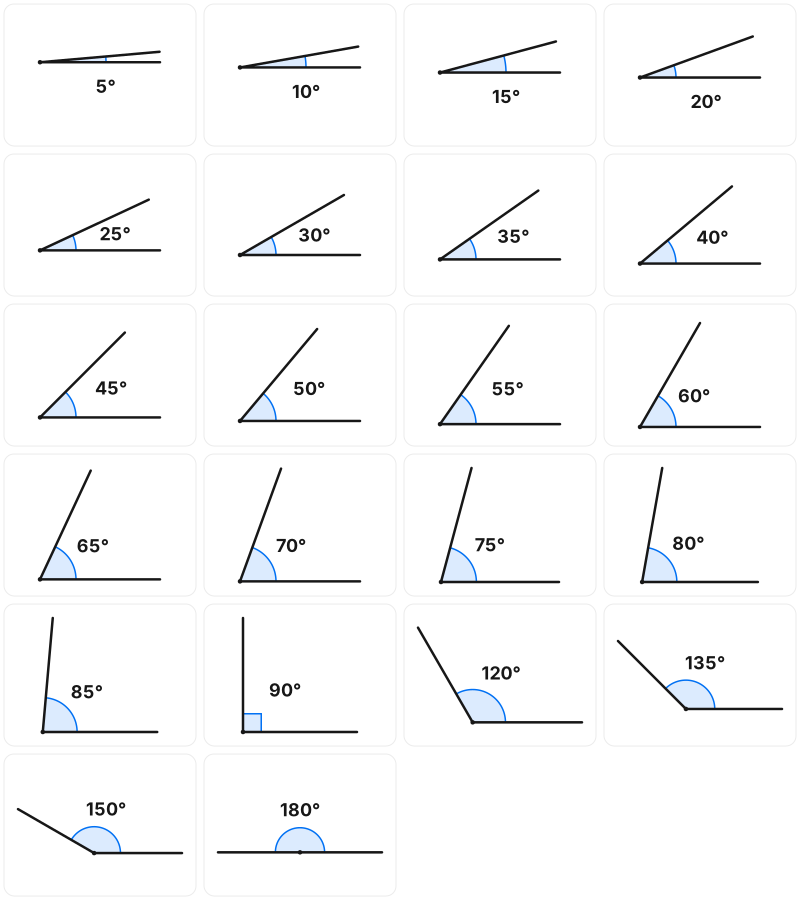
Every angle from 5° to 90° in 5° steps, then the common obtuse angles. Angles smaller than 90° are acute, exactly 90° is a right angle, anything between 90° and 180° is obtuse, and 180° is a straight angle: a straight line. See types of angles for all of them.
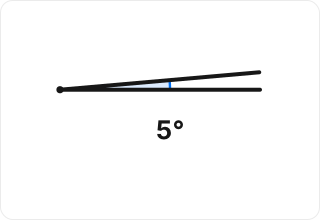
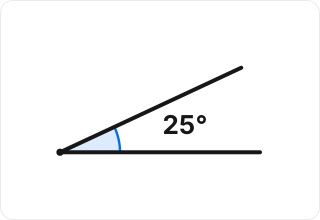
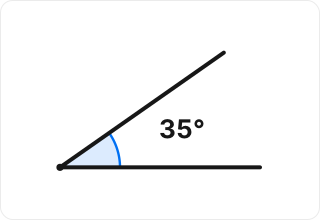
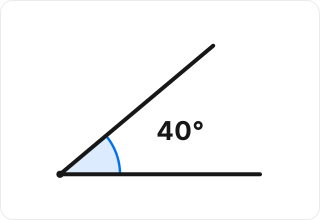
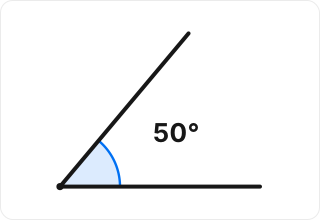
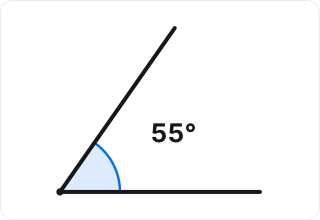
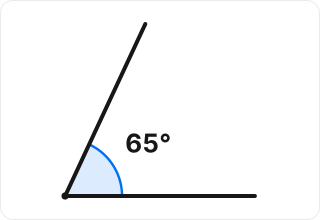
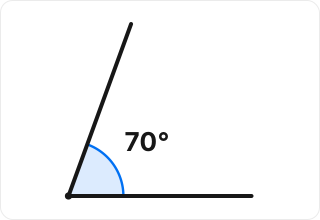
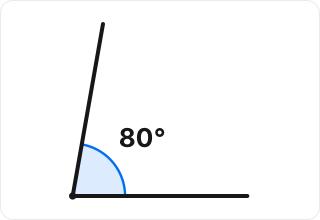
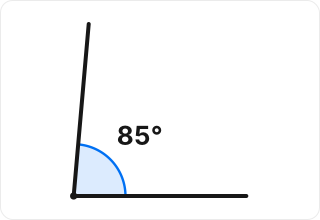
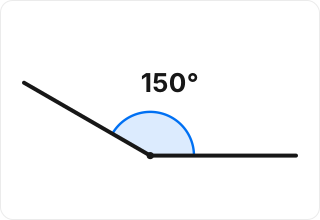
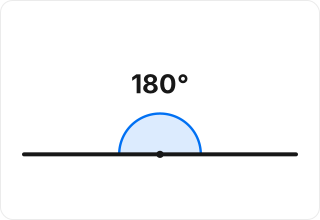
Open the whole chart as one image to save or print it.
45 degree angle
A 45° angle is exactly half a right angle: the angle you get by cutting a square in half from corner to corner.
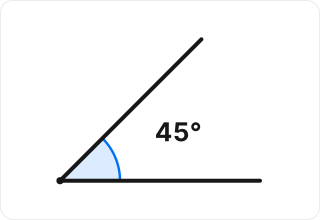
What a 45° angle looks like
The diagonal of any square meets its sides at 45°. That is why a 45° line rises exactly as far as it runs: go 10 cm along and 10 cm up, and the line from the start to that point is at 45°.
How to make a 45° angle without a protractor
- Tape measure: from a square corner, mark the same distance along both edges and join the two marks. The joining line is at 45° to each edge.
- Paper: fold the corner of a sheet so its two edges lie exactly on top of each other. The crease halves the 90° corner into two 45° angles.
- Speed square or set square: the long edge of a speed square and the sloping side of a 45° set square are both at 45°.
- Compass: construct a right angle, then halve it.
How to check a 45° angle
Lay your phone along the surface and open the inclinometer set to 45°: it shows how far off you are and tells you when you reach it. For a line on paper or a screen, use the on-screen protractor, or print a 45° template.
How to cut a 45° angle
Set a miter saw to 45° and cut the end of both pieces: the two 45° ends meet in a 90° corner, as in a picture frame. That only works when the corner really is 90°. Walls and old frames often are not, so measure the corner first and let the miter angle calculator split it.
Where you see 45°
- A roof that rises 12 inches for every 12 inches of run, a 12/12 roof pitch, is at 45°.
- A 100% slope is 45°, not 90°: percent grade is rise divided by run, and at 45° the two are equal. The slope calculator converts between them.
- Setting a gym bench to 45°? See incline bench angle.
- Type
- Acute angle
- Radians
- π/4 ≈ 0.7854
- Complement
- 45°
- Supplement
- 135°
- Slope grade
- 100.0%
- Roof pitch
- 12.00:12
30 degree angle
A 30° angle is a third of a right angle and one twelfth of a full turn.
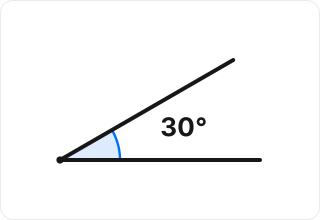
What a 30° angle looks like
The hour marks on a clock face are 30° apart, so the hands at 1 o’clock make a 30° angle. A 30° line is fairly shallow: it rises about 57.7 cm over a 100 cm run.
In a right triangle with a 30° angle, the side opposite that angle is exactly half the longest side, the hypotenuse. That gives an easy way to build one.
How to make a 30° angle without a protractor
- Ruler, using the half-length rule: draw a baseline, then a second line parallel to it 5 cm above. Put the ruler’s zero on the point where the angle should start and swing the ruler until its 10 cm mark touches the upper line. The ruler’s edge is now at 30° to the baseline.
- Paper: fold an upright sheet in half so the side edges meet, then open it, leaving a crease up the middle. Fold one bottom corner up until the corner touches that crease, keeping the fold pinned at the other bottom corner. The new fold meets the bottom edge at 30°.
- Compass: construct a 60° angle and halve it.
- Set square: the narrowest corner of a 30-60-90 set square is 30°.
How to check or cut a 30° angle
Check a surface with the inclinometer set to 30°, or print a 30° template. On a miter saw, 30° is the cut for a six-sided frame, since 180° ÷ 6 = 30°: the miter calculator works this out for any number of sides.
Setting an incline bench to 30°? It is the setting most often recommended for the upper chest: see incline bench angle.
- Type
- Acute angle
- Radians
- π/6 ≈ 0.5236
- Complement
- 60°
- Supplement
- 150°
- Slope grade
- 57.7%
- Roof pitch
- 6.93:12
60 degree angle
A 60° angle is two thirds of a right angle and one sixth of a full turn. Every corner of an equilateral triangle is 60°.
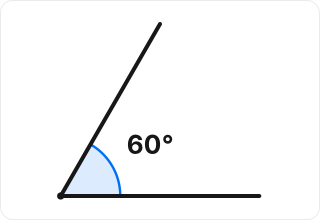
What a 60° angle looks like
It is the angle between the hands of a clock at 2 o’clock. A 60° line is steep: it rises about 173 cm over a 100 cm run.
How to make a 60° angle with a compass
- Draw a baseline and mark the point where the angle starts.
- With the compass point on that mark, draw an arc that crosses the baseline.
- Without changing the compass width, move its point to where the arc crosses the baseline and draw a second arc that crosses the first.
- A line from the starting point through the crossing is at exactly 60°.
It is exact because the starting point, the first crossing and the second crossing are all one compass width apart: an equilateral triangle. The paper fold in the 30° section gives 60° too: the line from the pinned corner to where the other corner landed is at 60°.
Where you see 60°
- A regular hexagon splits into six equilateral triangles, so each side spans 60° from the centre. The polygon angle calculator gives every angle of any regular polygon.
- A triangular frame is cut at 60° on a miter saw (180° ÷ 3). Check that your saw’s scale goes that far before you plan on it.
- Type
- Acute angle
- Radians
- π/3 ≈ 1.0472
- Complement
- 30°
- Supplement
- 120°
- Slope grade
- 173.2%
- Roof pitch
- 20.78:12
90 degree angle
A 90° angle is a right angle: a quarter turn, the corner of a square. Two lines at 90° to each other are perpendicular.
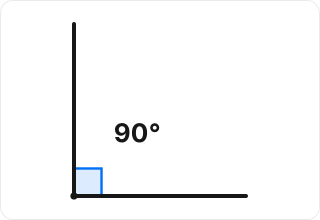
How to make or check a 90° angle with a tape measure
- From the corner, measure 3 units along one edge and mark it.
- Measure 4 units along the other edge and mark that.
- Measure between the two marks. At exactly 5 units the corner is 90°. More than 5 means the corner is wider than 90°; less than 5 means it is tighter.
Any multiple works, and bigger is more accurate: use 6-8-10 or 9-12-15 for a deck, a slab or a garden bed. The other two angles of that 3-4-5 triangle are 36.87° and 53.13°.
Other ways to check a right angle
- Diagonals: for a rectangular frame, measure both diagonals. If they are equal, and opposite sides are equal, every corner is 90°.
- Compass: from a point on a line, mark equal distances either side of it. From each mark, draw an arc above the line with a wider setting. The line from the point through the arcs’ crossing is at 90°.
- Phone: the inclinometer’s plumb mode shows whether a post or wall is truly vertical, and its reference mode measures the angle between two surfaces, so a wall-to-floor reading of 90° is square.
Cutting a 90° corner
A square cut is 0° on a miter saw’s scale. A 90° corner made from two pieces is two 45° cuts.
- Type
- Right angle
- Radians
- π/2 ≈ 1.5708
- Complement
- —
- Supplement
- 90°
- Slope grade
- —
- Roof pitch
- —
15 degree angle
A 15° angle is a sixth of a right angle: half of 30°.
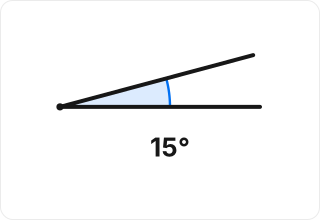
What a 15° angle looks like
A gentle incline: it rises about 26.8 cm over a 100 cm run. On a clock, the minute hand turns 15° in two and a half minutes.
How to make a 15° angle
- Compass: construct 60°, halve it to 30°, then halve that.
- Set squares: put a 45° set square inside the 60° corner of a 30-60-90 set square; the gap left over is 15°.
- Tape measure: mark a 100 cm run and a rise of 26.8 cm (see the layout table).
A twelve-sided frame is cut at 15° (180° ÷ 12). For a bench, 15° is a low incline: see incline bench angle.
- Type
- Acute angle
- Radians
- π/12 ≈ 0.2618
- Complement
- 75°
- Supplement
- 165°
- Slope grade
- 26.8%
- Roof pitch
- 3.22:12
22.5 degree angle
A 22.5° angle is half of 45° and one sixteenth of a full turn. It is mostly a woodworking and plumbing angle.
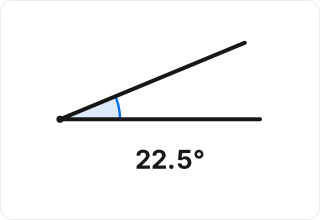
Where 22.5° is used
- Octagons: eight pieces cut at 22.5° close into an eight-sided frame or box, since 180° ÷ 8 = 22.5°. See the miter calculator for 8 sides.
- 135° corners: trim around a corner that turns 45°, like the angled walls of a bay window, is cut at 22.5° on each piece: miter settings for a 135° corner.
- Pipe fittings: a “1/16 bend” turns 22.5°, a sixteenth of a full circle.
How to make a 22.5° angle
Halve a 45° angle: fold a square corner in half, then in half again. With a tape measure, a 100 cm run needs a rise of 41.4 cm. Or print a 22.5° template at true size and mark straight from it.
- Type
- Acute angle
- Radians
- π/8 ≈ 0.3927
- Complement
- 67.5°
- Supplement
- 157.5°
- Slope grade
- 41.4%
- Roof pitch
- 4.97:12
Other common angles: 20°, 72°, 75°, 120° and 135°
20 degree angle
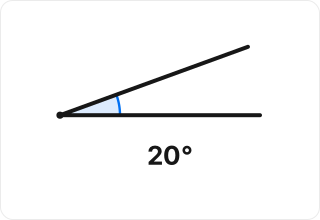
A 20° line rises about 36.4 cm over 100 cm. It comes up most in knife sharpening, where edges are described in degrees per side and figures from about 15° to 20° are often quoted. A printed 20° template beside the stone gives you something to match by eye.
72 degree angle
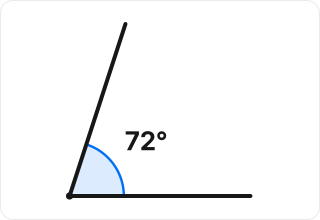
360° ÷ 5 = 72°: seen from the centre of a regular pentagon, neighbouring corners are 72° apart. The pentagon’s inside corners are 108°, and a five-sided frame is cut at 36°. The polygon angle calculator gives all of these for any number of sides.
75 degree angle
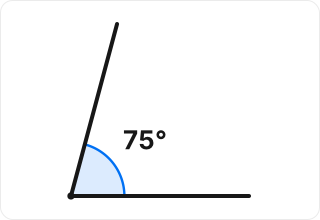
75° = 45° + 30°, so a 45° set square and a 30-60-90 set square placed side by side make one. It is steep, rising about 373 cm over a 100 cm run. A ladder whose foot stands out from the wall by a quarter of its length leans at about 75.5°. On a bench, 75° is a nearly upright back pad, common for seated presses.
120 degree angle
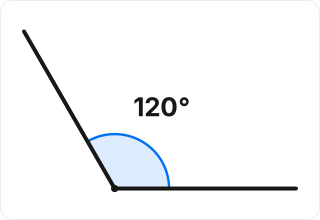
An obtuse angle: 180° − 60°. The inside corners of a regular hexagon are 120°, and so is the angle between the hands of a clock at 4 o’clock. With a compass, step the 60° construction twice around the same arc.
135 degree angle
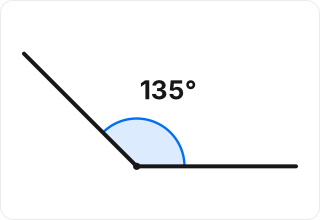
135° = 90° + 45°. It is the inside corner of a regular octagon, such as a stop sign, and the corner where the angled wall of a typical bay window meets the main wall. To draw it, construct a right angle on a straight line, then halve the 90° left over on the other side.
Small angles as a rise: 0.5° to 15°
Small angles are easier to set out as a rise over a distance than with a protractor. The rise is the run multiplied by the tangent of the angle: a 1° slope rises about 17.5 mm per metre, and a 5° slope about 87.5 mm.
| Angle | Grade | Rise per metre | Rise per foot | Ratio |
|---|---|---|---|---|
| 0.5° | 0.87% | 8.7 mm | 0.105 in | 1 in 114.6 |
| 1° | 1.75% | 17.5 mm | 0.209 in | 1 in 57.3 |
| 1.5° | 2.62% | 26.2 mm | 0.314 in | 1 in 38.2 |
| 2° | 3.49% | 34.9 mm | 0.419 in | 1 in 28.6 |
| 3° | 5.24% | 52.4 mm | 0.629 in | 1 in 19.1 |
| 4° | 6.99% | 69.9 mm | 0.839 in | 1 in 14.3 |
| 5° | 8.75% | 87.5 mm | 1.050 in | 1 in 11.4 |
| 6° | 10.51% | 105.1 mm | 1.261 in | 1 in 9.5 |
| 7° | 12.28% | 122.8 mm | 1.473 in | 1 in 8.1 |
| 8° | 14.05% | 140.5 mm | 1.686 in | 1 in 7.1 |
| 9° | 15.84% | 158.4 mm | 1.901 in | 1 in 6.3 |
| 10° | 17.63% | 176.3 mm | 2.116 in | 1 in 5.7 |
| 12° | 21.26% | 212.6 mm | 2.551 in | 1 in 4.7 |
| 15° | 26.79% | 267.9 mm | 3.215 in | 1 in 3.7 |
For any other angle or distance, the slope calculator solves rise, run and length from any two values.
10 degree angle
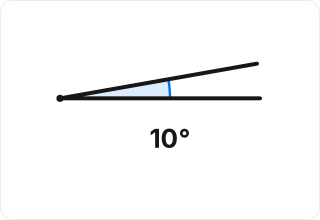
A 10° slope rises 176 mm over a metre, or about 2.12 inches per foot: a grade of 17.6%. Mark the run and rise with a tape measure, or check a surface with the inclinometer set to 10°.
How to make any angle without a protractor
With a tape measure
Mark a run along a straight edge. From the end of the run, measure the rise straight up at 90° to the edge. The line from the start of the run to the top of the rise is at the angle you want, because rise = run × tan(angle).
| Angle | Rise over a 100 cm run | Rise over a 12 in run |
|---|---|---|
| 5° | 8.7 cm | 1.05 in |
| 10° | 17.6 cm | 2.12 in |
| 15° | 26.8 cm | 3.22 in |
| 20° | 36.4 cm | 4.37 in |
| 22.5° | 41.4 cm | 4.97 in |
| 25° | 46.6 cm | 5.60 in |
| 30° | 57.7 cm | 6.93 in |
| 35° | 70.0 cm | 8.40 in |
| 40° | 83.9 cm | 10.07 in |
| 45° | 100.0 cm | 12.00 in |
| 50° | 119.2 cm | 14.30 in |
| 55° | 142.8 cm | 17.14 in |
| 60° | 173.2 cm | 20.78 in |
Past 60° the rise gets long and small errors grow. Lay out the complementary angle from the upright edge instead: for 70°, set out 20° from the vertical.
By halving an angle
A compass halves any angle exactly. With the point on the corner, draw an arc across both arms. From each crossing, draw an arc of the same width inside the angle so the two meet. A line from the corner through that meeting point splits the angle in two. From 90° you get 45°, 22.5° and 11.25°; from 60° you get 30° and 15°.
With a printed template
The printable protractor marks any angle you enter and prints it at true scale, with a check bar to confirm your printer did not resize it. Cut along the marked line and you have a template to trace or set a bevel from.