Incline bench angle
The angle of an incline bench changes who does the work: lower inclines keep a press on the chest, steeper ones hand it to the front of the shoulders. Here is what each setting does, what the research found, and how to find the angle your bench is really at.
How to find your bench’s real angle
Adjustable benches are usually marked with notches or numbers rather than degrees, and the same notch sits at a different angle on different benches. The reliable way to know is to measure it, and your phone can do that.
- Open the inclinometer on your phone. The link sets a target of 30°; change it to the angle you want.
- Lay the phone flat on the back pad, lengthwise, along the middle of the pad rather than on the frame or an edge.
- Move the pad a notch at a time until the reading says it is on target, or note which notch comes closest.
Note what each notch measures once and you will not need to check again. If the floor itself slopes, the reading includes that. For the angle between the seat and the back pad alone, use the inclinometer’s reference mode: capture the seat, then measure the back pad.
Best incline bench angle
For the upper chest, about 30° is the best-supported choice. A 2020 study measured muscle activity in 30 trained adults bench pressing a barbell with the bench at 0°, 15°, 30°, 45° and 60°. Activity in the upper chest was highest at 30°. Above 30°, the front of the shoulder (the anterior deltoid) became significantly more active while all three parts of the chest became less active, and the shoulder was most active at 60°. The flat bench produced the most activity in the middle and lower chest.
Keep its limits in mind. Every set was done at one moderate load, 60% of each person’s one-repetition maximum, and muscle activity during a lift is not the same as long-term muscle growth. Treat 30° as a sound starting point rather than a rule, and if your shoulders take over, try a notch lower.
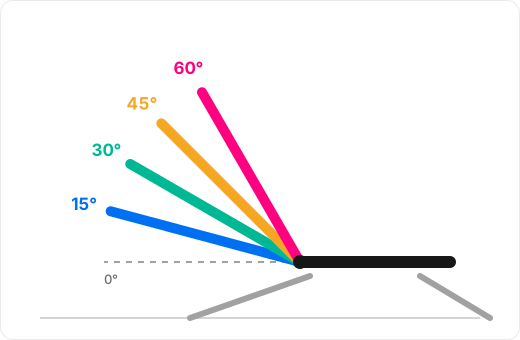
15°, 30°, 45° and 60° incline bench angles
15 degree incline bench
A small step up from flat. The study tested 15°, but the upper-chest peak came at 30°, not 15°. A 15° setting keeps the press close to a flat bench, which suits anyone who finds steeper angles uncomfortable on the shoulders.
30 degree incline bench
The angle where the study recorded the highest upper-chest activity, below the point where the front deltoids started to take over. It is the usual choice for incline presses aimed at the upper chest.
45 degree incline bench
Steeper than the upper-chest peak. In the study, inclines above 30° moved significantly more of the work to the front deltoids and reduced chest activity. 45° is also a common setting for chest-supported rows and incline curls, covered below.
60 degree incline bench
Closer to a seated shoulder press than a chest press. The study recorded the most front-shoulder activity at 60°, with the chest working less than at lower inclines.
30° vs 45° incline
What the study found when the same lifters pressed at both angles:
| 30° incline | 45° incline | |
|---|---|---|
| Upper chest | Highest of the five angles tested | Less active than at 30° |
| Front shoulder | Less active | Significantly more active |
| Triceps | Similar | Similar |
| Suits | Presses aimed at the upper chest | Presses with more shoulder involvement; rows and curls |
Bench angle for other exercises
Beyond pressing, these are settings commonly used in gyms. They are conventions rather than research findings, so use them as a starting point and adjust to what feels right. Each link opens the inclinometer aimed at a typical angle in the range.
| Exercise | Common setting | Why | Check it |
|---|---|---|---|
| Incline dumbbell or barbell press | 15–30° | Upper-chest focus. The study above found the upper-chest peak at 30°. | Measure 30° |
| Incline dumbbell fly | 15–30° | The same chest focus as the incline press. | Measure 30° |
| Seated dumbbell shoulder press | 75–90° | A near-upright back keeps the work on the shoulders. | Measure 80° |
| Incline dumbbell curl | 45–60° | The arms hang behind the body, putting the biceps on a stretch. Lower settings stretch further. | Measure 45° |
| Chest-supported dumbbell row | 30–45° | Lying chest-down on the pad takes the lower back out of the lift. | Measure 45° |
| Decline bench press | 15–30° decline | Head below the hips, a common variation for the lower chest. The phone reads a decline the same way, as degrees from flat. | Measure 20° |
Fixed incline benches and Smith machines
A fixed incline bench, or the bench that lives under a Smith machine, is set at whatever angle its maker chose, and it is not always marked. Measure it the same way before assuming it matches the angle in a program. To see what any of these angles looks like drawn to scale, use the angle viewer.
Common questions
What is the best incline bench angle?
About 30° for most people training the upper chest. In the study described above, upper-chest activity peaked at 30°, and steeper inclines moved more of the work to the front of the shoulders. If your shoulders take over, try a notch lower.
Is there a standard incline bench angle?
No. Adjustable benches are marked with notches or numbers rather than degrees, the same notch sits at a different angle on different benches, and fixed incline benches are set wherever the maker chose. The only way to know is to measure your bench with your phone.
What angle should an incline dumbbell press be?
A setting of 15–30° is common for the incline dumbbell press, the same range as the barbell version; 30° matches the upper-chest peak the study found with a barbell. For other exercises, see the bench angle table.
Source
Rodríguez-Ridao D, Antequera-Vique JA, Martín-Fuentes I, Muyor JM. Effect of Five Bench Inclinations on the Electromyographic Activity of the Pectoralis Major, Anterior Deltoid, and Triceps Brachii during the Bench Press Exercise. International Journal of Environmental Research and Public Health. 2020;17(19):7339. doi:10.3390/ijerph17197339