Types of angles
Angles are named by their size: acute, right, obtuse, straight, reflex and full. Try any angle in the classifier, see each type with real examples, and learn the angle pairs that appear wherever lines cross.
What kind of angle is it?
Drag the handle or type an angle, and the classifier names it and gives its range.
50°Acute angleMore than 0° and less than 90°
Drag the handle, tap the drawing, or type an angle.
- Radians
- 0.8727 rad
- ComplementAdds up to 90°
- 40°
- SupplementAdds up to 180°
- 130°
What is an angle?
An angle is the amount of turn between two lines, called arms, that meet at a point called the vertex. Its size does not depend on how long the arms are drawn.
Angles are usually measured in degrees: a full turn is 360°, so a quarter turn is 90°. Mathematics and engineering also use radians, where a full turn is 2π. The angle converter switches between degrees, radians and other units.
The six types of angles
Every angle from 0° to 360° falls into one of these types.
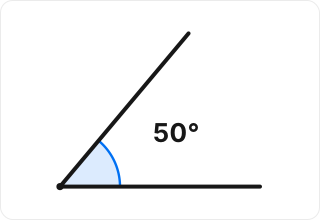 Acute angleMore than 0° and less than 90°
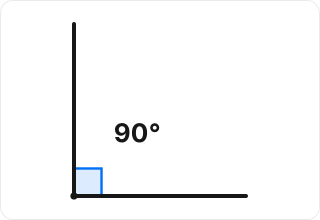 Right angleExactly 90°
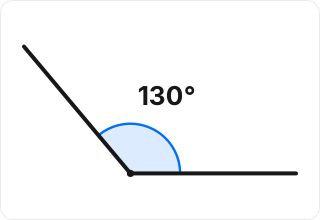 Obtuse angleMore than 90° and less than 180°
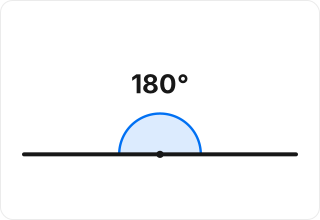 Straight angleExactly 180°
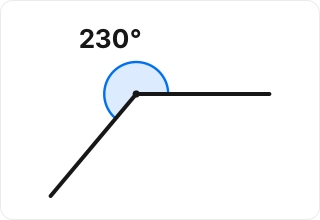 Reflex angleMore than 180° and less than 360°
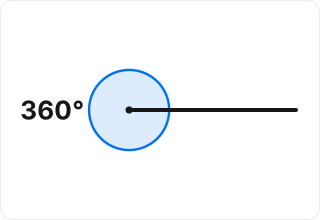 Full angleExactly 360°
Acute angle
An acute angle is more than 0° and less than 90°: narrower than the corner of a square.
- The tip of a slice of pizza or a wedge of cheese.
- The hands of a clock at 1 or 2 o’clock.
- Scissors opened a little way.
To tell, hold the corner of a sheet of paper against it: if the angle fits inside the corner, it is acute. See 30°, 45° and 60° angles for how to make the common ones.
Right angle
A right angle is exactly 90°, a quarter turn. It is drawn with a small square in the corner, and two lines that meet at a right angle are perpendicular.
- The corners of a book, a door or a tile.
- The hands of a clock at 3 o’clock.
- A wall meeting a level floor.
To check a real corner, use the 3-4-5 rule: 3 units along one side, 4 along the other, and exactly 5 between the marks means 90°. More ways to make and check a 90° angle.
Obtuse angle
An obtuse angle is more than 90° and less than 180°: wider than a square corner, but not yet a straight line.
- A laptop screen tilted back past upright.
- The hands of a clock at 5 o’clock.
- The inside corners of a hexagon, 120°.
If the corner of a sheet of paper fits inside the angle with room to spare, and the arms do not form a straight line, it is obtuse.
Straight angle
A straight angle is exactly 180°, a half turn. Its two arms point in opposite directions and form a straight line, so any point on a straight line can be seen as the vertex of a straight angle.
- A book lying fully open and flat.
- The hands of a clock at 6 o’clock.
Reflex angle
A reflex angle is more than 180° and less than 360°. Every angle less than a full turn has a reflex partner: the other way round the vertex. A 60° angle and a 300° reflex angle share the same two arms.
The partner that makes up a full turn is called the explement; the complementary and supplementary angles calculator works it out along with the complement and supplement.
Full angle
A full angle, or complete angle, is exactly 360°: one whole turn, where the arm comes back to where it started. A zero angle, 0°, is the opposite: both arms point the same way and there is no turn at all.
Angle pairs
Some angles are named for how they relate to another angle. Complementary angles add up to 90° and supplementary angles add up to 180°; the complementary and supplementary angles calculator finds either one and checks any pair.
Adjacent angles, vertical angles and linear pairs
When two lines cross, they make four angles. Drag one line to see how they relate.
- a
- 50°
- b
- 130°
- c
- 50°
- d
- 130°
a and c are vertical angles, so both are 50°. b and d are too, so both are 130°.
a and b form a linear pair: 50° + 130° = 180°.
Drag the handle or use the arrow keys.
- Adjacent angles share a vertex and one arm and do not overlap, like a and b.
- Vertical angles, also called vertically opposite angles, sit across the vertex from each other, like a and c. They are always equal.
- A linear pair is two adjacent angles whose outer arms form a straight line, like a and b. They always add up to 180°.
Angles on parallel lines
A line that crosses two other lines is called a transversal. It makes four angles at each crossing, and when the two lines are parallel, those angles pair up in predictable ways.
In the same position at each crossing.
62° and 62°: equal, because the lines are parallel.
Drag the handle or use the arrow keys. Clear “The lines are parallel” to tilt the lower line.
- Corresponding angles are in the same position at each crossing. On parallel lines they are equal.
- Alternate interior angles lie between the two lines, on opposite sides of the transversal. On parallel lines they are equal.
- Alternate exterior angles lie outside the two lines, on opposite sides of the transversal. On parallel lines they are equal.
- Co-interior angles, also called same-side interior angles, lie between the lines on the same side of the transversal. On parallel lines they add up to 180°.
This also works in reverse: if corresponding or alternate angles are equal, the two lines must be parallel.
Angle of elevation and angle of depression
The angle of elevation is the angle you look up through, from the horizontal to something above you, such as the top of a tree. The angle of depression is the angle you look down through, from the horizontal to something below, such as a boat seen from a cliff. Seen from each end of the same line of sight, the two angles are equal.
If you know how far away something is, the angle of elevation gives its height: height = distance × tan(angle).
How to measure an angle of elevation with your phone
- Open the camera protractor and aim the crosshair at the top of what you are measuring.
- Read the angle, or hold the reading so you can note it down.
- Enter the distance to the base to get the height. The inclinometer also works: sight along the phone’s long edge.
Example: you stand 20 m from a tree and sight its top at 35°. The height above your eyes is 20 × tan 35° ≈ 14.0 m. Add your eye height, about 1.6 m, and the tree is about 15.6 m tall. The slope calculator does the same sum for any distance and angle.
The angle of inclination of a slope, a ramp or a roof is its angle of elevation above the horizontal. The slope calculator converts it to a percentage grade or a ratio.
How to measure an angle
- On a screen or a drawing: place the on-screen protractor over the angle and drag its arms onto the lines.
- In a photo: open the picture in the photo measurement tool and mark three points.
- On a real surface: lay your phone on it and read the inclinometer.
- On paper: print a protractor at true size.
When you read a paper protractor, put its centre mark on the vertex, line up the zero line with one arm, and read the scale that starts from zero on that arm. Using the other scale gives the supplement by mistake.
Common questions
How many types of angles are there?
By size there are six: acute, right, obtuse, straight, reflex and full, and some lists add the zero angle to make seven. Longer lists of 12 or more also count angle pairs such as complementary, supplementary, adjacent and vertical angles, which describe how two angles relate rather than how big one angle is.
What type of angle is 95°?
Obtuse. Any angle more than 90° and less than 180° is obtuse, however close it is to 90°.
Is a 90° angle acute?
No. Acute angles are less than 90°. An angle of exactly 90° is a right angle.
What types of angles are in a triangle?
Every triangle has at least two acute angles, and the third angle gives it its name: an acute triangle has three acute angles, a right triangle has one right angle, and an obtuse triangle has one obtuse angle.
Can a triangle have two obtuse angles?
No. The three angles of a triangle add up to 180°, and two obtuse angles alone would already come to more than that. A triangle has at most one right angle or one obtuse angle; the triangle calculator solves any triangle from three values.
What is the difference between a straight angle and a reflex angle?
A straight angle is exactly 180°. A reflex angle is any angle between 180° and 360°, bigger than a straight line but short of a full turn.
What types of angles does a square or parallelogram have?
A square, like every rectangle, has four right angles. A parallelogram that is not a rectangle has two acute and two obtuse angles: opposite angles are equal, and any two angles next to each other add up to 180°, so they are supplementary.